Major Arcana
Justice Tarot Card Meaning: Upright, Reversed & In Love
Justice tarot card meanings — fairness, accountability, cause and effect. Upright and reversed Justice card in love, career and legal matters, with the Rider-Waite-Smith card description.
The Justice tarot card is card XI of the Major Arcana — the tarot card of fairness and balance, of cause and effect, of decisions that have to be honest with themselves. It is not vengeance and not luck. The Justice tarot card meanings, across tarot cards and any tarot deck, all return to one idea: the slow, fair return of what was put out. When the Justice card appears in your reading, a situation is being weighed — and the verdict belongs to truth, not preference. This is a trump card, one of the cleaner-edged cards in the Major Arcana.
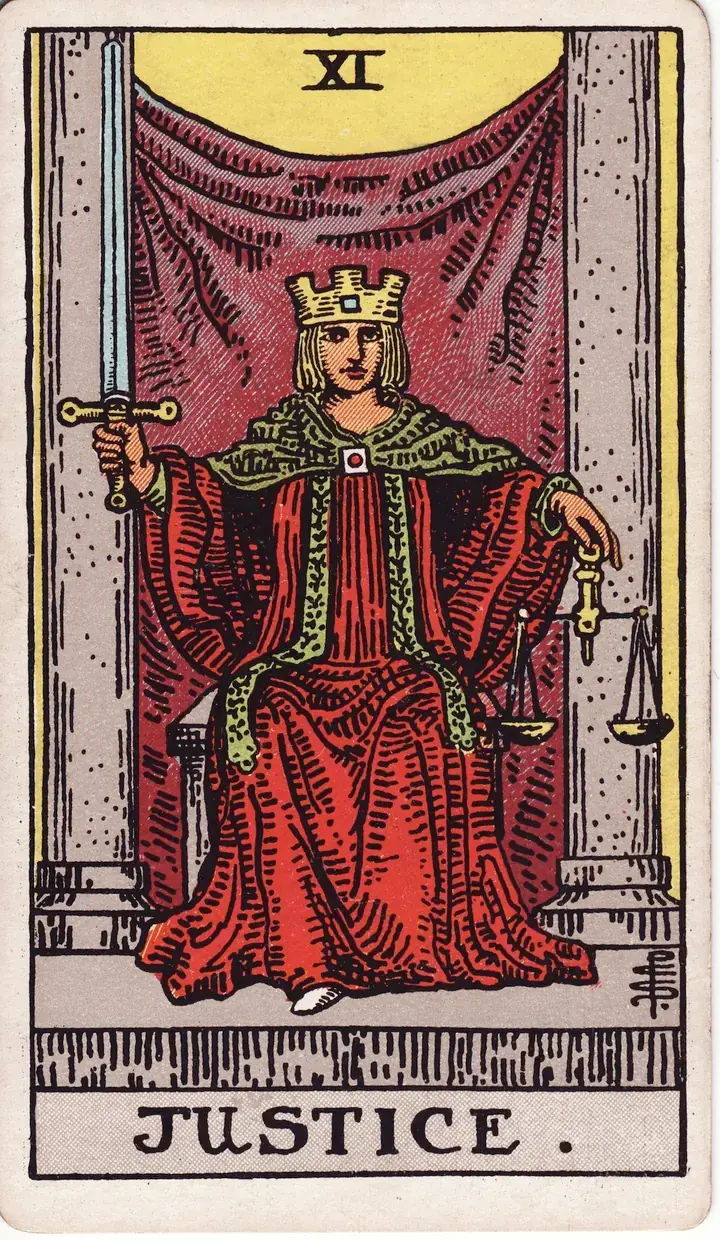
In the Rider-Waite-Smith card description, the figure of Justice (Lady Justice in many readings) sits between two stone pillars, robed in a red robe with a green clasp at the throat. She holds an upright sword in her right hand and balanced scales in her left. A small white shoe peeks from under the robe. The figure looks straight at you. No blindfold. Justice in tarot is not blind — the scales of justice see clearly, and are unmoved by the part of you that hopes for a different answer.
What the Justice card really means
Justice names a moment when the consequences of your actions are landing — fairly, even if uncomfortably. It also names an important decision you need to make with full honesty, weighing real costs and real needs rather than wishful thinking. The card is associated with legal matters and contracts, but its reach is broader: any current situation that asks for a clean accounting falls under this Major Arcana tarot card.
The sword in her right hand is the truth (the part that cuts through fantasy); the scales represent the weighing (the part that compares honestly). You need both, in this order. The Justice card is also a karma card in the practical sense: not cosmic punishment, but the predictable return of patterns you keep repeating.
Justice keywords
Justice upright: fairness, accountability, cause and effect, balance and harmony, truth, integrity, a fair and balanced outcome, legal clarity, impartiality, accept responsibility, take accountability for the choices you make.
Justice reversed: unfairness, dishonesty, imbalance, avoidance of accountability, blame others, bias, an unfair outcome you contributed to, decisions made on partial information, the dishonesty that lets the scales tip the wrong way.
Justice upright — meaning
Upright, the Justice card favours honest reckoning. A contract going through fairly. A relationship rebalancing because someone finally named the imbalance. A consequence that, while not gentle, is just. The upright Justice card supports doing the right thing even when easier options exist — and trusts that the right thing eventually returns the benefit. The card is also a good card to draw when you need to take a step back and reassess a current situation with honest eyes.
The Justice card upright signals that the consequences of your actions are catching up — and that, contrary to fear, that’s usually fine. If you’ve been fair and balanced, the verdict will be too. The card also surfaces around moments when balance in your life needs to be actively restored, not just hoped for. Sometimes the Justice card can also mark a settlement, a long-overdue apology, or the moment someone finally takes responsibility for their actions.
Justice reversed — meaning
Justice reversed is the verdict refused. Someone is dodging responsibility, refusing to weigh the truth, or making a decision based on partial information. Reversed, the card asks: what truth have you been avoiding, and what’s the cost of continuing to avoid it?
Justice reversed is rarely about external persecution; it’s usually about the small lies we tell ourselves about a situation. The reversed card can also signify an unfair outcome you can still challenge, or the karma of a pattern you haven’t been willing to name. Either way, the card is asking you to make amends, not to spiral in guilt.
Justice in a love and relationships reading
Upright: a relationship rebalancing — a long-overdue conversation, a fair share of work and care finally negotiated. Sometimes the card marks the moment a partnership ends fairly, with both people clear about what happened. The Justice in a love reading is rarely punitive; it’s a request for honesty, on both sides. If single, the card supports honest assessment of past patterns before the next chapter of your love life.
Justice reversed in love: a relationship distorted by avoidance. One partner refusing accountability, or both colluding to never name the imbalance. The card asks for the honest conversation — gently if possible, plainly if necessary. Sometimes the Justice card can also mark the moment you stop expecting to be treated fairly by someone who won’t be, and exit cleanly.
Justice in career and finances
Upright: a fair outcome at work — a long-deserved promotion, a contract resolved in your favour because the case was solid, or a career decision made with clear eyes. Financially: a settlement, an inheritance, or a debt being honoured. The Justice card here is also the card of clean books and honest paperwork.
Justice reversed in career: career or financial unfairness — wage gaps, a contract dispute going wrong, an accountant or partner being dishonest. The card asks for transparent records and clear standing-up-for-yourself, not aggression but accuracy. Reversed, the card is also a prompt to learn from your mistakes rather than hand the same situation to a future version of yourself.
Justice and health
The Justice card can signify a body asking for balance — sleep, food, movement, rest — rather than a body asking for a verdict. A recovery that has finally found its rhythm. If a real health question is on your mind, see a doctor, not a tarot card or oracle spread.
Yes or no answer
Justice gives a clear answer based on the truth of the situation. If your actions and intentions have been honest, it is a yes. If they haven’t, it is a no — and the card is asking you to make that right before expecting a yes. Justice as a yes/no card is rarely warm and rarely wrong. The card is also a request to seek balance before forcing the question further.
In the Rider-Waite-Smith justice card description
The double pillars frame the figure of Justice — as they do the High Priestess and the Hierophant — placing her at the threshold of conscious decision. The upright sword is truth, vertical and double-edged: it cuts both directions, and Justice is unmoved by which side it cuts. The scales represent the weighing of cause and effect, alive and balancing in real time.
Her crown has a small blue square in the centre — clarity of thought. The purple-red robe is the weight of authority earned, not inherited; the green clasp at the throat hints at growth that comes from honest accounting. The cloud behind the figure is the veil of contingency that justice has to see through. There is no blindfold on this Justice — she symbolizes Justice that sees the situation as it is, including the parts you hoped wouldn’t count.
In astrology, the Justice tarot card is associated with Libra — the sign of the scales — and the Libran themes of fairness, impartiality, partnership and the careful weighing of options. The card is also sometimes read alongside the Wheel of Fortune (chance) and Judgement (call) as the trio of Major Arcana cards that handle consequence in the deck.
Justice and the Hierophant
Where the Hierophant blesses by tradition, Justice judges by principle. Both sit between pillars; both wear robes of authority. But the Hierophant is concerned with what’s handed down; Justice with what’s fair right now. A reading that pairs the two often points to a tension between inherited rules and present truth — and Justice usually wins.
How readers approach Justice in a tarot reading
When the Justice card in your tarot reading shows up, most experienced readers don’t sugar-coat it. The card appearing on the table is asking for one specific thing: an honest accounting. The sense of justice that lives within us is being summoned — not the external verdict. Surrounding cards usually tell you what kind of accounting it is. A Tower nearby means the truth is going to land hard; a Star nearby means the verdict, while real, will be followed by relief.
If you’d like to dispense with a reader and meet Justice through a free tarot draw, sit with the image first. The sword is upright. The scales are level. You probably already know what’s being weighed.
When Justice brings up a real question
If Justice has shown up in your reading, something is being weighed. You probably already know what. The reading is rarely about whether the verdict is fair — it’s about whether you can accept the consequences cleanly, or whether you’ll keep arguing with them. If you’d like to talk that through with a calm outside voice, talk to a real reader — sometimes the verdict gets easier to hear once a thoughtful person says it out loud, and the card is a good prompt for the conversation rather than a final word.
Our beginner’s guide to reading tarot walks through Justice and the full Major Arcana in plain language — useful if you’d like to read your own tarot cards. The wand of intention, the sword of truth and the scales of justice all live in the same Rider-Waite-Smith iconography for a reason: action, honesty, weighing.
In one line
The Justice tarot card is the card of honest reckoning — fairness and balance, given form. The verdict is fair once you stop arguing with it.
Tarot card meanings are offered for reflection and entertainment, not as advice or prediction.
For reflection and entertainment — tarot is not a prediction of outcomes, and not a substitute for professional advice. 18+.